
Stitched into the blazers worn by Methodist Ladies’ College (MLC) students is the Latin motto: Per ardua ad alta — through effort to higher achievement.
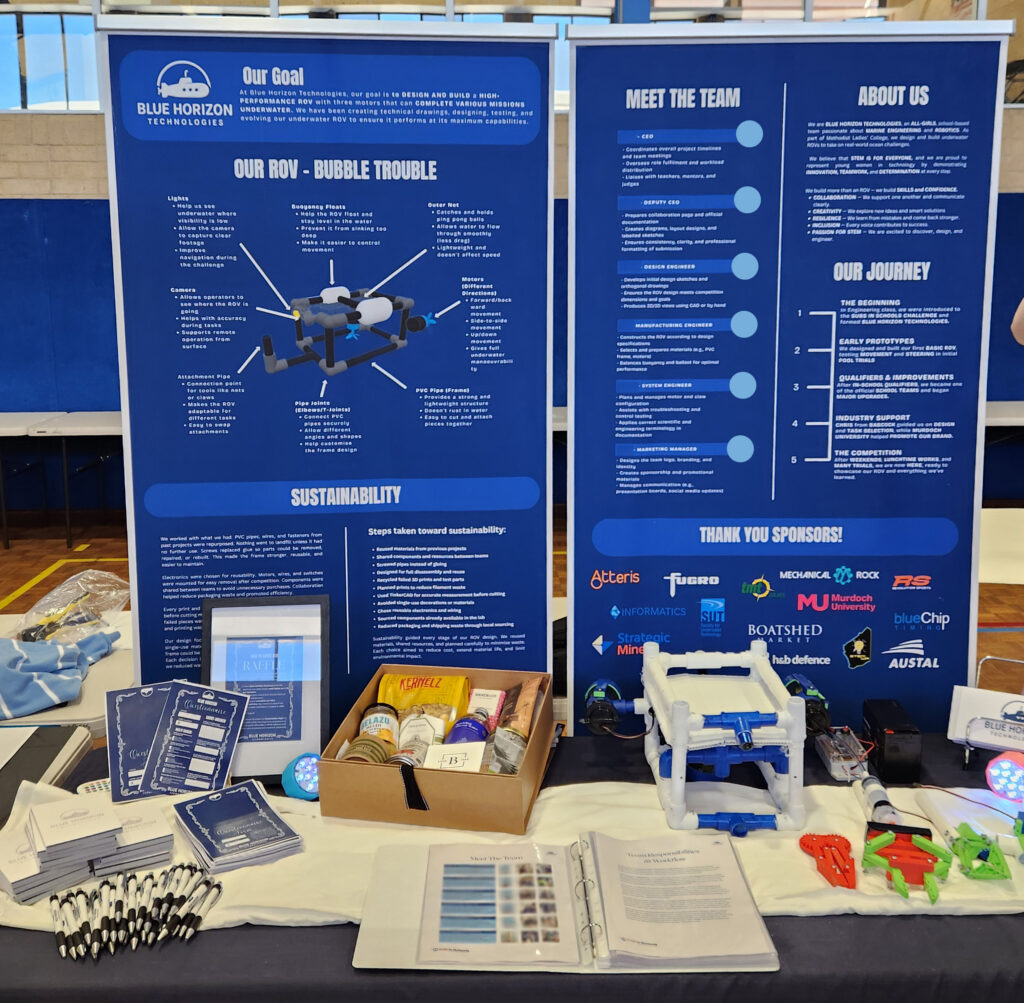
It’s a sentiment often echoed by armed forces, and one that found new expression for a group of MLC Year 9 students poolside at HMAS Stirling on Garden Island in late 2025, when they guided a submersible Remotely Operated Vehicle (ROV) made of PVC pipe, motors, and big ideas, to a podium finish at the STEM WA Subs in Schools competition.
For months beforehand, the Blue Horizon Technologies team had refined and stress‑tested ideas for their ROV, working after school, on weekend and during the school holidays to bring their engineering concepts to life. They also leaned on industry for guidance, enlisting the help of H&B Defence’s Principal Manufacturing Engineer, Chris Cheng, to sharpen their thinking.
“They were in the middle of designing a claw for their ROV that would be used in a series of underwater challenges,” Chris recalls. “Sometimes simplicity is the key to success, so we stripped the discussion back to purpose: Was the claw necessary to complete the mission? Did it need to move or could it just be a hook? We also looked at buoyancy on the PVC frame, making sure trapped air could escape once the ROV hit the water. The team went on to make the vent holes a lot bigger.”
It wasn’t about removing complexity for its own sake; it was about designing for the mission. The students adapted quickly, learning to let function lead form — an insight that served them well across three days of competition.
Alongside underwater manoeuvring, they operated like a start‑up company: delivering presentations, building a trade-booth display, and refining a marketing pitch to secure sponsorship. They also connected closely with students from other schools, including Wilderness School in South Australia, sharing ideas and comparing design choices.
In the end, Blue Horizon Technologies finished second overall, just five points shy of first place, an outcome powered as much by teamwork and resilience as by technical skill.
Their success reflects a school culture that encourages girls to experiment and take informed risks. At MLC, integrated STEM isn’t an add‑on. It’s woven through learning in ways that help students imagine futures in engineering, technology, and emerging fields they haven’t yet seen.
“There is definitely a want to expand and build on STEM opportunities,” MLC Science & Engineering teacher Kim Coddington said. “Our role is to open doors and show our girls that their talent belongs in every room, including STEM.”
That’s why programs like Subs in Schools matter. They push students beyond the classroom and give them the chance to apply their learning in a real-world context, solving complex problems, working as a team, and adapting under pressure.
Industry partnerships elevate that experience even further.
“To get girls into the fields of STEM, engineering, technology, and computing is hard, so having that visibility and a sounding board is so important,” Kim says. “Having Chris work alongside our students brought authenticity to their learning; they weren’t just hearing theory, but seeing how a professional thinks, problem‑solves, and collaborates.”
The impact was immediate. As one student put it after the competition: “I didn’t realise this industry existed. How cool would it be to design something on a future submarine?”
Real‑world guidance also reshaped how students approached failure.
“Before, they thought failing was a bad thing,” Kim said. “Then they realised: ‘If I fail, how can I look at this and see what worked, and how can I change what didn’t?’ By the end of the year, if something didn’t work, they changed their approach. That growth was great to see.”
Chris knows the impact of early exposure.
“We had engineers visit my school when I was a student, and I remember being genuinely inspired,” he says. “Meeting real people who’d gone down the STEM path, and seeing their successes, gave me the confidence that I could do it too.”
He also sees these moments as essential for Australia’s future workforce.
“Workforce is a challenge, and, ultimately, a national security issue. We need thousands of engineers for AUKUS, as well as across the broader defence sector. Programs like this show students what’s possible, and that matters at a national level.”
For H&B Defence, supporting initiatives like Subs in Schools is a strategic investment in Australia’s next generation of engineers, connecting students with real projects, people, and purpose. For MLC, it’s a reminder that higher achievement emerges from effort.
“It is a very challenging and intensive STEM program,” Kim said. “They learned how to run a start‑up company, manage time effectively, build timelines in Excel, and handle all the intricacies of constructing an ROV. They also had a scrutiny test, where they were asked complex questions to make sure they had built the ROV themselves. It exposed them to what a true STEM project is and that’s what made it so invaluable.”
Per ardua ad alta. Infinite possibilities, a ‘blue horizon’ within reach.