
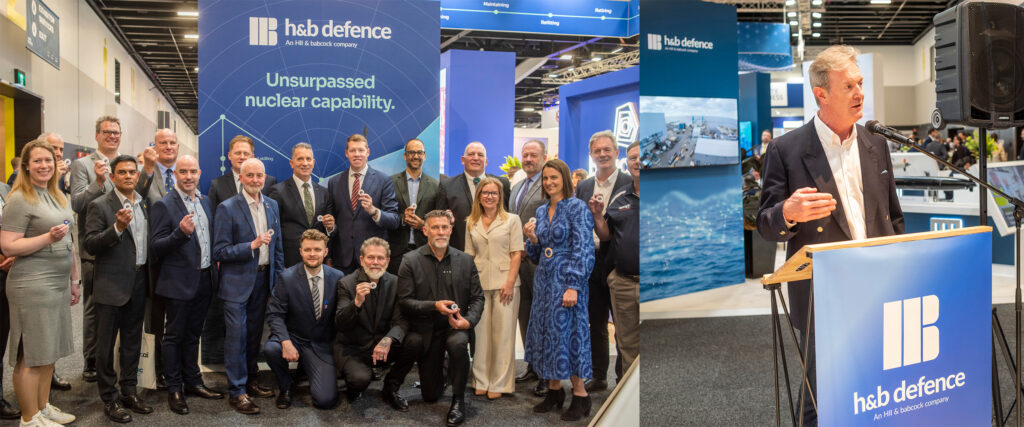
The first cohort of Australian businesses benchmarked through H&B Defence’s Australian Submarine Supplier Qualification (AUSSQ) Program have each been successfully validated against HII’s Newport News Shipbuilding (NNS) division standards, paving the way for their formal qualification into the US nuclear submarine enterprise.
The announcement, made today at INDOPAC 2025, highlights Australia’s continued progress in defence industry integration under AUKUS.
The companies, which include CQMS, AW Bell, AJAX, Hycast, Intercast, Supashock, Camco, Stella, Ferra, Axiom and Marand, have undergone rigorous assessments after being selected to join AUSSQ for their respective strengths in high-demand areas: castings, forgings, and precision machining.
Each supplier is now progressing through a series of required uplift activities to secure formal qualification into the NNS supply chain.
They seek to join eight other Australian businesses already qualifed by H&B Defence through state-led capability uplift programs. Of these suppliers, three have already received formal Requests for Quotation (RFQs) from NNS, opening direct access to US contract opportunities.
Led by the Australian Submarine Agency and delivered by H&B Defence, the AUSSQ Program has rapidly matured into a proven and effective model for preparing Australian businesses to compete in one of the world’s most demanding defence supply chains.
A further 12 suppliers are also progressing through the AUSSQ quailification pipeline for air and gas system components and fabricated parts, following a $9.3 million program expansion, announced in the US last month by Minister for Defence Industry Pat Conroy. Additional rounds of participants, targeting new priority capability areas, are expected to be announced in the new year.
H&B Defence Board Chair Michael Lempke said:
“The AUSSQ program is delivering real capability, real opportunity, and real momentum to position Australian businesses for AUKUS export opportunities in the US.”
“The recent $9.3 million expansion to include 12 more businesses, as announced by Minister Conroy last month, demonstrates the strength of the delivery model, which combines targeted uplift, rigorous qualification, and strategic alignment with US defence requirements.”
H&B Defence Managing Director Tim Brown said:
“The pace and quality of supplier readiness emerging from Australia reflects the depth of its industrial cooperation under AUKUS. It shows that Australia is stepping up with its AUKUS partners and delivering capability where it counts.”
“The success of the AUSSQ pilot proves that Australian industry is not only capable but ready to contribute to the future of nuclear submarine capability.”
Western Australia Defence Minister Paul Papalia said:
“My goal is to see Western Australia’s defence sector grow into our second biggest industry after mining, creating generations of jobs and diversifying our economy.”
“The AUSSQ program, which began as a successful pilot in WA has helped a number of our local businesses including Hofmann Engineering, Dobbie, Marine Technicians Australia, Pressure Dynamics and VEEM advance towards achieving strict US approvals, with others now in the pipeline.”
“WA’s defence industry is playing a key role in deepening Australia’s partnership with the US and can assist in delivering Virginia-class submarines under AUKUS.”
South Australia Minister for Industry, Innovation and Science Joe Szakacs said:
“The South Australian Government is proudly supporting local companies to qualify for the US nuclear shipbuilding supply chain.”
“Advanced manufacturing is a key economic driver for South Australia, and our government is commited to maximising the benefits of the unprecedented opportunity that SSN-AUKUS provides our state’s industry and economy.”
Axiom Managing Director Craig Maynard said:
“Working with H&B Defence has been very collaborative, with excellent support to work through the supplier on-boarding requirements. The on-site audit and audit report provided areas for uplift, with H&B supporting these uplift requirements, fitting within our current system rather than needing to create customer specific documentation.”